Congenital absence of the vas deferens
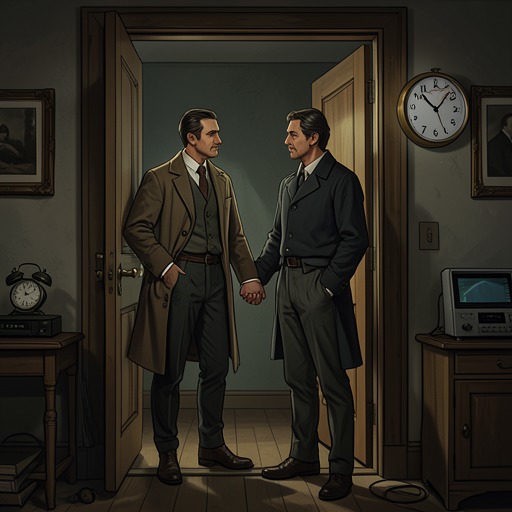
The GodmotherCongenital absence of the vas deferens is the condition Will Raphael discloses to Rachel Elliot when explaining that he cannot have children. The revelation turns an undisclosed bodily fact into a defining pressure on their developing relationship: after hearing that Rachel wants a child, Will has tried to resist seeing her, fearing the conflict between his infertility and her hopes for motherhood.
Condition and disclosure
Will describes the condition as congenital and explains that sperm do not make it past the first post. He presents the consequence categorically: he cannot have children. The account offers no further medical description or treatment history; its focus is what the condition means within his intimate life and what he chooses to tell Rachel.
The disclosure comes over dinner, after Will has insisted that Rachel stay so they can talk. He sets down his knife and fork, folds his arms, and says there is something she needs to know—the reason he has been trying not to see her and resisting her. Rachel initially responds playfully, but his direct statement that he cannot have children changes the conversation at once. The condition is not introduced as abstract medical information: it is the withheld truth behind his withdrawal.
Discovery and its history
Will says he found out about the congenital condition while he was with Ginnie. He also says it was one of many things that depressed her about him and about life. His brief account connects the diagnosis to the history of his marriage, but does not explain how the discovery occurred or describe Ginnie’s response beyond that assessment. The condition is therefore revealed through Will’s recollection of its emotional place in their relationship, rather than through clinical detail.
That history also helps explain why disclosure feels consequential to him. Will does not initially say the condition was the sole reason he avoided Rachel. He recalls that it did not weigh on him so much at first; his hesitation sharpened after Anita Cavanagh mentioned Rachel’s interest in having children. His decision to hold back is thus tied not only to infertility itself but to what he believes Rachel’s wish makes relevant between them.
Rachel’s desire for motherhood
The disclosure lands against Rachel’s established determination to become a mother. She has written in her diary that she has decided to have a child, and she has directly asked Nathan to provide the means of conception while promising that she would raise the child on her own. Her request makes clear that she is not asking a prospective father for a conventional partnership or continuing parental commitment; she is trying to secure the possibility of motherhood on terms she can control.
Later, when Rachel reunites with Robbie Dexter, she secretly stops using contraception without telling him. She weighs the deception against her age, the value of each remaining cycle, and her growing belief in a future with him; she also tells herself that she could cope alone if that future failed. These choices show how insistently she pursues pregnancy, but also how her pursuit can conflict with candour and shared decision-making. Will’s revelation therefore arrives within a wider story of reproductive desire shaped by personal resolve, partnership, and the limits of control.
Relationship and significance
Rachel immediately asks whether Will’s absent vas deferens is why he decided they should not see each other. Her question brings the condition’s relational consequence into the open: the issue is not simply whether Will can father a child, but whether he has made Rachel’s decision for her by withdrawing before she could respond to the truth. Will’s explanation establishes his fear and hesitation; Rachel’s question challenges the assumption that his infertility alone settles what a relationship between them can be.
The condition also complicates the novel’s treatment of motherhood and reproductive possibility. An article Rachel encounters asks why conception is becoming increasingly problematic and notes the growth in couples seeking infertility treatments. Will’s congenital condition gives that broader concern an intimate form, while the plot places it beside Rachel’s determination, her earlier request to Nathan, and her concealed attempt to conceive with Robbie. The book does not treat fertility as a simple measure of desire or romantic compatibility: Will’s disclosure forces the characters to confront how bodily circumstance, personal hopes, and the choices made within relationships can pull in different directions.